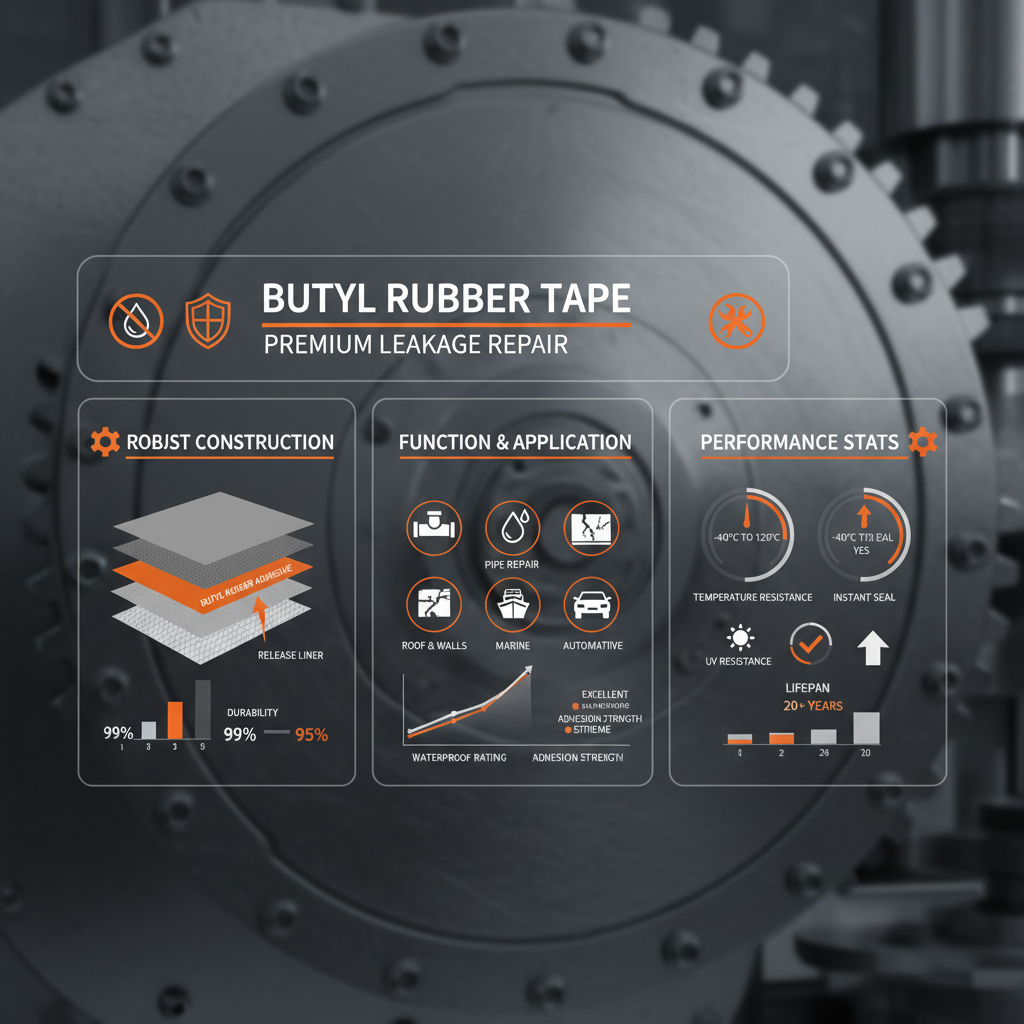
Selecting a reliable sealing solution for high-voltage cable joints often comes down to a balance between adhesive strength and environmental resilience. In industrial power distribution, the failure of a sheath repair can lead to moisture ingress, causing catastrophic electrical faults.
The demand for specialized sealing materials has pushed the industry toward high-performance polymers that can withstand extreme temperature fluctuations and chemical exposure. Specifically, the role of butyl rubber tape china has become pivotal for engineers seeking a non-vulcanizing, waterproof barrier that maintains flexibility over long periods.
This analysis examines the technical logic behind butyl-based sealing, the critical parameters for evaluating material quality, and the practical frameworks for implementing these tapes in complex infrastructure repairs.


Butyl rubber is a copolymer of isobutylene-isoprene, characterized by its extremely low permeability to gases and water vapor. Unlike standard rubber, its molecular structure provides a unique "tacky" nature that allows it to form a permanent bond without the need for heat or chemical catalysts.
In the context of butyl rubber tape china, this material is engineered to act as a moisture barrier. Its high viscosity prevents it from flowing under pressure, while its elasticity ensures that it can accommodate the thermal expansion and contraction of the cables it protects.
When evaluating professional-grade tapes, such as the XF-KJD series, technical indicators must be scrutinized based on ASTM standards. Total thickness is a primary factor; for instance, a 0.3mm thickness provides a critical balance between application ease and barrier integrity. Tensile strength and elongation at break indicate how much the tape can stretch during winding without snapping, ensuring a tight, overlapping seal.
Peel strength is perhaps the most critical metric for long-term reliability. The ability of a tape to maintain a 1.5 N/cm bond to steel even at 180℃ demonstrates its stability in high-temperature industrial environments. This prevents the tape from delaminating when the underlying cable heats up during peak load periods.
Furthermore, the unwind force (typically between 2-6 N/19mm) ensures that the technician can apply the tape with consistent tension. Inconsistent tension leads to gaps in the sealing layer, which are the primary entry points for water and corrosive agents in underground installations.
Cable sheath repair is a high-stakes operation. Whether dealing with communication inflatable cables or power cable joints, the goal is to restore the original hermetic seal. Mechanical damage to the outer jacket allows moisture to migrate along the cable core, which can cause insulation breakdown over time.
Effective armor protection requires a composite approach: using a butyl rubber base for waterproofing, followed by industrial armor-wrap for mechanical protection against abrasion and impact.
The implementation involves cleaning the substrate to remove contaminants and applying the butyl tape in a spiral wrap. This method creates a redundant series of seals. In pipeline plugging repair, the same logic applies—the tape must displace air and adhere instantly to irregular surfaces to prevent leaks under pressure.
Different industrial environments place varying stresses on sealing materials. In subterranean power grids, the primary challenge is constant moisture and soil acidity. In automotive wire harnesses, the focus shifts to vibration resistance and thermal cycling.
The following relative index demonstrates how different tape materials perform across these specific operational demands, highlighting the specialized role of butyl rubber in moisture-critical zones.
In a typical industrial setting, the application of sealing tapes is rarely a standalone process. For instance, when repairing a high-voltage power cable sheath, technicians may first use a semi-conducting adhesive tape to manage the electrical field, followed by a layer of butyl rubber tape china for absolute waterproofing.
The final layer often consists of a PVC electrical tape or a flame-retardant rubber tape to provide UV protection and fire resistance. This layered approach ensures that if one layer is compromised by external abrasion, the butyl core continues to prevent moisture from reaching the conductor.
Safety regulations in public infrastructure and transportation are shifting toward Low Smoke and Halogen-free (LSZH) materials. Traditional PVC tapes, while effective for insulation, can release toxic hydrochloric acid gas when burned. This has led to an increased adoption of self-bonding fire-resistance tapes in tunnels and skyscrapers.
The industry is also seeing a move toward hybrid materials that combine the waterproof properties of butyl rubber with the arc-resistance of specialized EPDM (Ethylene Propylene Diene Monomer) rubber. These hybrids are designed to survive the intense heat of a short-circuit event without melting away.
As smart grids expand, the requirement for materials that can withstand higher frequencies and temperatures is increasing. This necessitates more rigorous testing of peel strength and dielectric properties to ensure that the sealing solution does not become a point of electrical failure.
Choosing the wrong tape for a specific repair can lead to premature failure. PVC is excellent for general insulation and color-coding but fails in high-moisture environments due to its permeability. EPR (Ethylene Propylene Rubber) is the gold standard for high-voltage insulation but does not offer the same "sealing" or gap-filling properties as butyl.
A decision framework must prioritize the primary threat: if the threat is water ingress, butyl is mandatory. If the threat is electrical tracking, EPR or semi-conducting tapes are the priority. For simple mechanical bundling in automotive harnesses, polyester fabric or PVC tapes suffice.
The table below provides a relative suitability matrix to assist engineers in selecting the appropriate material based on the specific operational constraints of the project.
| Material Type | Waterproofing | Dielectric Strength | Thermal Stability | Primary Use Case |
|---|---|---|---|---|
| Butyl Rubber | Excellent | Moderate | High | Sheath Repair / Plugging |
| EPR Rubber | Good | Excellent | Very High | High-Voltage Insulation |
| PVC Tape | Fair | Good | Moderate | General Electrical Wrap |
| Silicone Rubber | Excellent | High | Extreme | High-Temp Sealing |
| Cloth Tape | Poor | Low | Low | Harness Bundling |
| Semi-Conducting | Moderate | N/A | High | Stress Control / Field Grading |
Butyl rubber is a specific copolymer with an extremely low gas and water vapor permeability rate. Unlike standard acrylic or rubber adhesives, butyl remains tacky and flexible over a wider temperature range and does not harden or crack, making it ideal for long-term underground cable sealing where moisture exclusion is the primary requirement.
The surface must be completely free of dust, oil, and moisture. It is recommended to use a solvent cleaner (such as isopropyl alcohol) on the cable jacket. Any protrusions or jagged edges from the armor should be smoothed. Ensuring a clean substrate is critical because butyl relies on molecular adhesion to create a watertight seal.
No. Butyl rubber tape is primarily a sealing and waterproofing material, not a primary dielectric insulator. For high-voltage applications, it should be used as part of a system, typically placed over EPR (Ethylene Propylene Rubber) or other insulating layers to protect those layers from water ingress.
Elongation at break (e.g., 180% for XF-KJD) indicates the tape's ability to stretch during application. High elongation allows the technician to apply tension, which compresses the butyl material into the irregularities of the cable surface, eliminating air pockets and ensuring a void-free seal.
Yes, provided the grade is correct. High-quality butyl tapes are tested for peel strength at elevated temperatures (e.g., 180℃). While they remain stable, the specific thermal limits should be verified against the product's technical data sheet to ensure the adhesive doesn't soften excessively in extreme heat.
A composite approach manages different risks. A thin layer of butyl provides the waterproof seal; a layer of EPR provides the electrical insulation; and an outer wrap of PVC or armor provides mechanical protection. Relying on a single material usually forces a compromise in one of these three critical areas.
The integrity of industrial electrical systems depends heavily on the quality of the smallest components, including the tapes used for sealing and protection. As we have seen, the technical superiority of butyl rubber in moisture exclusion makes it indispensable for cable sheath and pipeline repairs.
For procurement and engineering teams, the focus should remain on verifiable technical metrics—such as ASTM-D-1000 peel strength and elongation—rather than generic product descriptions. By integrating a layered material strategy, operators can ensure that their infrastructure remains resilient against both electrical and environmental stressors for decades.