In the current electrical infrastructure market, procurement managers are increasingly scrutinizing the balance between material cost and long-term dielectric reliability. When analyzing the pvc electrical insulation tape price, it is evident that the cost is not merely a reflection of raw PVC resin markets, but a complex interplay of adhesive chemistry, thickness precision, and flame-retardant additives.
The volatility of polymer pricing and the demand for stricter safety certifications have made it challenging for engineers to maintain budget predictability without compromising on safety. Whether for automotive wire harnesses or industrial control panels, the selection of an insulating medium must account for the total cost of ownership, including the risk of premature degradation and subsequent maintenance downtime.
This technical analysis examines the factors driving market pricing, the engineering specifications that justify premium costs, and how to optimize selection based on application environments. For those exploring high-performance alternatives, understanding the transition to pvc electrical insulation tape price and specialized rubber solutions is critical for system longevity.


The pricing structure of PVC insulation tape is primarily driven by the grade of the polyvinyl chloride resin and the quality of the plasticizers used to ensure flexibility. High-grade tapes utilize specialized additives that prevent the migration of plasticizers over time, which prevents the tape from becoming brittle in extreme temperatures.
Manufacturing overheads also play a role; the use of precision coating machines and strict quality testing on technical parameters, such as those employed by professional producers like Xiangfan, ensures consistency in thickness and adhesive strength, which commands a different price point than generic alternatives.
Thickness is a primary determinant of both performance and cost. For instance, a standard 0.5 mm thickness provides a specific dielectric barrier that must be balanced against the flexibility required for tight wraps. When the total thickness is maintained with high precision, the insulation resistance remains uniform across the entire roll, reducing the risk of localized electrical breakdown.
Tensile strength and elongation at break are critical engineering metrics. A product with a tensile strength of 20 N/cm and an elongation at break of 180% ensures that the tape can withstand mechanical stress during installation without tearing, which is a key requirement for automotive wire harness applications.
Furthermore, the peel strength to steel at 180℃ indicates the adhesive's thermal stability. Higher thermal resistance requires more advanced acrylic or rubber-based adhesives, which directly impacts the final pvc electrical insulation tape price by increasing the material cost of the adhesive layer.
The core function of insulation tape is to prevent current leakage and protect personnel from electric shock. The efficiency of this barrier depends on the purity of the PVC compound and the absence of air voids within the tape layers.
From a procurement perspective, opting for the lowest price often means accepting a higher rate of plasticizer leaching, which leads to shrinkage and the eventual exposure of conductive elements. This underscores the importance of verifying ASTM-D-1000 standards during the evaluation process.
To quantify the value proposition, we can look at a normalized engineering assessment. This doesn't just look at the price, but the ratio of performance (durability, insulation, and adhesion) relative to the cost.
The following data represents a relative assessment of different tape configurations based on industrial application requirements.
In a typical industrial deployment, such as the wrapping of automotive wire harnesses, the priority is flame retardancy and resistance to vibration. Using a flame-retardant PVC tape reduces the risk of fire propagation, justifying a higher initial pvc electrical insulation tape price compared to general-purpose office tapes.
For outdoor electrical installations, the focus shifts to UV resistance and waterproofing. In these scenarios, the engineering requirement is a tape that prevents ozone cracking and moisture ingress. Procurement teams can optimize costs by using standard PVC tape for internal components and reserving high-specification, weather-resistant tapes for exposed junctions.
The industry is moving toward "low smoke and halogen-free" (LSZH) materials to comply with stricter environmental and safety regulations in enclosed spaces like tunnels or aircraft. This shift represents a significant evolution in material science, as halogen-free alternatives must replicate the dielectric properties of PVC without the toxic combustion by-products.
We are also seeing an increase in the adoption of hybrid insulation systems, where a base layer of PVC is combined with a self-fusing silicone or EPR rubber outer layer. This approach optimizes the cost-to-performance ratio by using the PVC for primary insulation and the specialized rubber for environmental sealing.
Additionally, the integration of smart markers or conductive tracers within the tape structure is an emerging R&D direction, allowing for easier identification and testing of complex wire looms in automated manufacturing environments.
Selecting the correct tape requires a systematic comparison of environmental constraints and technical requirements. A buyer should not look at the price in isolation but evaluate the "cost per year of service life."
The following matrix provides a framework for selecting the appropriate configuration based on the intended application profile.
By aligning the configuration with the actual operational stress (thermal, chemical, or mechanical), companies can avoid the hidden costs of over-specification or the dangers of under-specification.
| Configuration Type | Key Performance Factor | Environmental Suitability | Recommended Use Case |
|---|---|---|---|
| Basic PVC | Standard Dielectric | Indoor / Stable Temp | General Electrical Repair |
| Flame Retardant | UL-Compliant Safety | Industrial Panels | Automotive Wire Harness |
| Weather-Resistant | UV / Ozone Stability | Outdoor / Exposed | External Power Junctions |
| Chemical-Grade | HCl / Oil Resistance | Industrial Plants | Chemical Processing Units |
| High-Voltage EPR | Extreme Dielectric Strength | High Tension Lines | Medium Voltage Splicing |
| Self-Fusing Silicone | Hermetic Sealing | Extreme Heat / Cold | High-Pressure Pipe Seals |
The primary price drivers include the quality of the PVC resin, the type of plasticizers used for flexibility, and the addition of specialized flame retardants or UV stabilizers. Furthermore, manufacturing precision—such as achieving a consistent 0.5mm thickness—requires advanced coating and cutting equipment, which influences the cost. Certifications (like RoHS) and adherence to international standards (ASTM-D-1000) also add value and cost to the production process.
Tensile strength, measured in N/cm, determines the tape's ability to resist breaking under tension during the wrapping process. For industrial applications like automotive harnesses, a high tensile strength (e.g., 20 N/cm) is required to ensure the tape remains tight and secure against vibrations. If the tensile strength is too low, the tape may snap or stretch excessively, leading to loose insulation and potential electrical failure.
Standard PVC tape has limited heat resistance. While some grades are enhanced with thermal stabilizers to maintain peel strength at 180℃ for short durations, continuous high-temperature exposure can cause the PVC to degrade and the adhesive to fail. For permanent high-heat applications, engineers should consider silicone rubber tapes or high-voltage EPR tapes, which are designed for superior thermal stability.
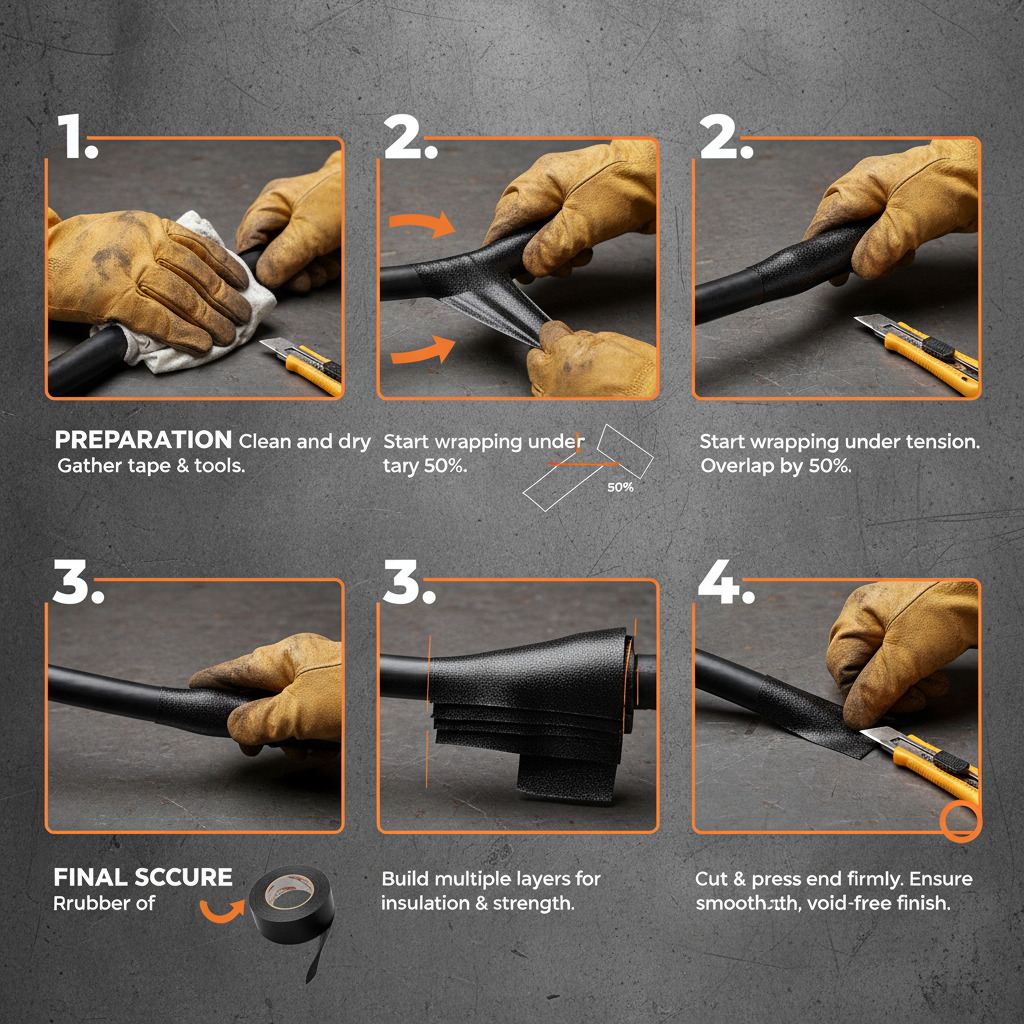
Elongation at break (e.g., 180%) indicates how much the material can stretch before it ruptures. High elongation is critical for achieving a tight, conformal wrap around irregular shapes or bundles of wires. This property ensures that the tape creates a continuous, void-free seal, which is essential for maintaining the dielectric integrity of the insulation and preventing moisture ingress.
Evaluate suppliers based on their quality management certifications (e.g., RoHS) and their ability to provide detailed technical data sheets. Look for specific test results regarding thickness, tensile strength, and peel strength. A reputable manufacturer, such as Xiangfan with over 20 years of experience, will have a complete production system including mixing, coating, and strict quality testing on technical parameters to ensure product consistency.
Self-fusing tapes should be used when a hermetic, waterproof, or high-pressure seal is required, as they bond to themselves to create a solid mass of rubber. Standard PVC tape is better suited for general insulation, color-coding, and light-duty bundling. While the unit price of self-fusing tape is higher, it eliminates the reliance on adhesives that can degrade over time in harsh environments.
Analyzing the pvc electrical insulation tape price reveals that value is derived from the intersection of material purity, mechanical strength, and environmental resistance. For most industrial applications, the cost of a premium, certified tape is a minor fraction of the total system cost, yet it serves as the primary defense against catastrophic electrical failure.
The practical implication for procurement is clear: prioritize technical specifications such as ASTM-D-1000 compliance and thermal stability over initial unit price. For critical junctions requiring absolute sealing and superior durability, integrating a hybrid approach with a pvc electrical insulation tape price and specialized rubber solution ensures maximum operational reliability.